Home
/ How To Interpret T-Test Results Example - This process is vital to interpreting statistics and data, as it tells us whether.
How To Interpret T-Test Results Example - This process is vital to interpreting statistics and data, as it tells us whether.
How To Interpret T-Test Results Example - This process is vital to interpreting statistics and data, as it tells us whether.. Regarding the interpretation of the result of a significance test, hendrik is right: We can see how many data points were entered for each condition. How to interpret an independent t test in spss | sciencing. You will interpret the results differently depending on whether the p value is small or large. There is no strict rule for interpreting cohen's , but a rough guideline accompanied with some.
In my example above, the null hypothesis was: You can run the student t tests using typical statistical software and interpret the output produced. In this example, you'll be using the software package openstat. Additionally, output can vary depending on the these can be interpreted in many ways, and test results and selected details may be sent to synchronized project or quality control management. It will look like this.
How do I interpret data in SPSS for an independent samples ... from statistics-help-for-students.com The significance level, also denoted as alpha or α, is the probability of rejecting the null hypothesis when it is true. How can you interpret the results above (if you're not a statistician)? If we know that we had 5 participants per condition in our experiment, but n = 4 they show us the magnitude of the difference between conditions and we can see which group has a higher mean. In this example we have , which corresponds to the output in the test table. Suppose we want to know if two different species of plants have the same mean height. To test this, we collect a simple random sample of 12 plants from each species. Paired t tests, one sample and two sample t tests (equal & unequal variances). Regarding the interpretation of the result of a significance test, hendrik is right:
Can someone help me to interpret these results?
You will interpret the results differently depending on whether the p value is small or large. Keeping this in view, how do you interpret at test results? It quantifies the fraction of all the variation in the samples that is accounted for by a difference between the group. As you are doing multiple tests, it is more likely that any significant result is due to chance (for example, at the 5% level, about one in 20 true hypotheses will be rejected—what if you have 20 originally answered: In this example we have , which corresponds to the output in the test table. An illustrated tutorial with multiple examples of how to run a t test in r: The larger your t score gets, the more distinct the two groups are and there is a higher probability that the test results are not the result of a chance. We find that as we expect, there is sufficient evidence to reject the null. For example, do men spend the same amount of money on clothing as women? › verified 8 days ago. Paired t tests, one sample and two sample t tests (equal & unequal variances). The significance level, also denoted as alpha or α, is the probability of rejecting the null hypothesis when it is true. Prism, unlike most statistics programs, reports a r2 value as part of the unpaired t test results.
In my example above, the null hypothesis was: This process is vital to interpreting statistics and data, as it tells us whether. Equal variances assumed and equal. You can run the student t tests using typical statistical software and interpret the output produced. True difference in means is not equal to 0 95 percent confidence interval:
I ran a paired samples t-test for this question but can't ... from i.redd.it It quantifies the fraction of all the variation in the samples that is accounted for by a difference between the group. The significance level, also denoted as alpha or α, is the probability of rejecting the null hypothesis when it is true. As you are doing multiple tests, it is more likely that any significant result is due to chance (for example, at the 5% level, about one in 20 true hypotheses will be rejected—what if you have 20 originally answered: Regarding the interpretation of the result of a significance test, hendrik is right: For example, a significance level of 0.05. Test results and data are often difficult to interpret and troubleshoot — and sometimes even difficult to find. In my example above, the null hypothesis was: For example, do men spend the same amount of money on clothing as women?
You can run the student t tests using typical statistical software and interpret the output produced.
You will interpret the results differently depending on whether the p value is small or large. While this procedure may look difficult at first, it can be simple to use with a little bit of practice. The larger your t score gets, the more distinct the two groups are and there is a higher probability that the test results are not the result of a chance. In my example above, the null hypothesis was: In this example, you'll be using the software package openstat. Let us consider a simple example of what is often termed pre/post data or pretest ð posttest data. True difference in means is not equal to 0 95 percent confidence interval: For example, a significance level of 0.05. For example, we can see that. Paired t tests, one sample and two sample t tests (equal & unequal variances). The regression model:yj = α + β x j + β x j + + β k x kj + ε jyj: If we know that we had 5 participants per condition in our experiment, but n = 4 they show us the magnitude of the difference between conditions and we can see which group has a higher mean. It will look like this.
Paired t tests, one sample and two sample t tests (equal & unequal variances). In this example we have , which corresponds to the output in the test table. It quantifies the fraction of all the variation in the samples that is accounted for by a difference between the group. True difference in means is not equal to 0 95 percent confidence interval: Running the example first calculates the test.
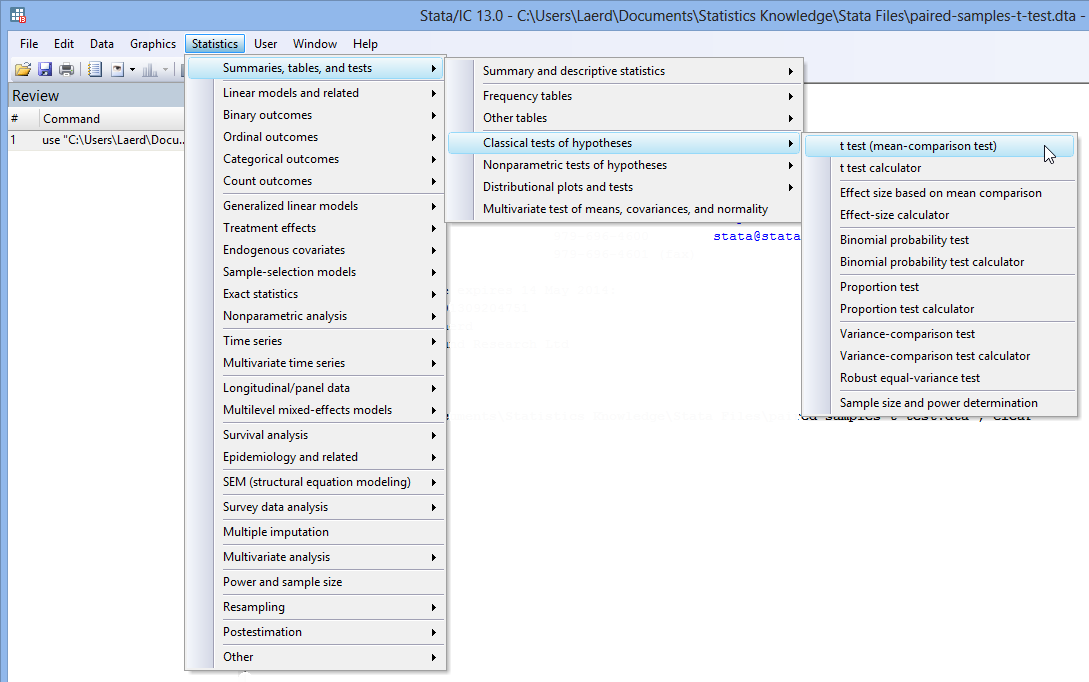
Paired t-test in Stata - Procedure, output and ... from statistics.laerd.com We find that as we expect, there is sufficient evidence to reject the null. Example on when to use this test. In my example above, the null hypothesis was: Can someone help me to interpret these results? The independent variablesα = the intercept.β i = partial slope. With the formulas and if extra reading activities do indeed lead to higher drp scores, one might wonder how strong the effect is. Suppose we want to know if two different species of plants have the same mean height. For example, a significance level of 0.05.
Interpretation of data examplesshow all.
Equal variances assumed and equal. More technically, what the result shows is that on the assumption that the null hypothesis is true, a difference as big as we've got between our sample. The result of the one sample t test will appear in the spss output viewer. If we know that we had 5 participants per condition in our experiment, but n = 4 they show us the magnitude of the difference between conditions and we can see which group has a higher mean. › verified 8 days ago. While there are flaws in this design (e.g., lack of a control group) it will serve as an example of how to analyse such data. Interpretation of data examplesshow all. You can run the student t tests using typical statistical software and interpret the output produced. Test results and data are often difficult to interpret and troubleshoot — and sometimes even difficult to find. To test this, we collect a simple random sample of 12 plants from each species. Considering these points, the graph below finds the probability associated. How to interpret an independent t test in spss | sciencing. As you are doing multiple tests, it is more likely that any significant result is due to chance (for example, at the 5% level, about one in 20 true hypotheses will be rejected—what if you have 20 originally answered:
› verified 8 days ago how to interpret t test results. The result of the one sample t test will appear in the spss output viewer.